
I know it doesn’t really matter, but I felt very strongly that Pluto should be demoted from being a planet. Now that it’s actually happened I feel sad that it’s happened. That means I’ve had two more emotions about Pluto than I ever expected to have.
Category Archives: Physics
Dark Matter, apparently not modern-day epicycles after all
Well, John Baez was right, the mysterious NASA press release about a dark matter discovery was about the Bullet Cluster.
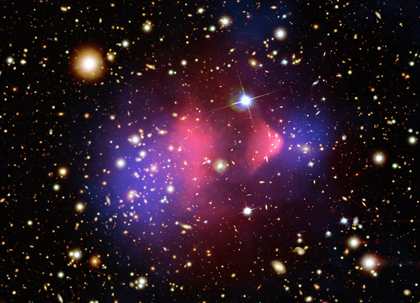
The discovery provides clear evidence in favor of dark matter, and against MOND. In the Bullet Cluster, when two clusters of galaxies collided, the regular matter in each cluster interacted, causing it to slow down, while the dark matter just kept going on its merry way. So while in a normal galaxy the gravitational forces pull towards the center of the visible galaxy, in the Bullet Cluster, the pull is now towards the bulge of dark matter to the side. It would be difficult to explain the discovery in the context of MOND — you would have to explain why in these particular galaxies the gravitational pull is asymmetric, while in most galaxies it’s symmetric.
So years of internet pundits are apparently wrong. Dark matter is not the new Ptolemaic epicycle. NASA’s article is here. Some animations of the collision can be found here.
The n-Category Café
John Baez of This Week’s Finds in Mathematical Physics fame, David Corfield of Philosophy of Real Mathematics fame, and Urs Schreiber of The String Coffee Table fame have banded together to form a new weblog, The n-Category Café, dedicated to n-category theory, and their potential applications to physics.
NASA Announces Dark Matter Discovery
Physics weblogs are all abuzz over a mysterious press release put by NASA entitled NASA Announces Dark Matter Discovery. The main body of the announcement reads:
Astronomers who used NASA’s Chandra X-ray Observatory will host a media teleconference at 1 p.m. EDT Monday, Aug. 21, to announce how dark and normal matter have been forced apart in an extraordinarily energetic collision.
Via Backreaction.
Update. John Baez has been on the case, and he’s deduced the meat of the announcement: a collision of two clusters of galaxies has apparently pulled galaxies and their dark matter halos apart. This provides compelling evidence in favor of the actual existence of dark matter. He has more in the comments, and at his website.
Grete Hermann
This thread about famous women mathematicians on Cocktail Party Physics, reminded me of an interesting figure in history that I came across while doing researching for a Wikipedia article: Grete Hermann. (The Wikipedia article is a skeleton that I created; it could use a lot of work.)
Hermann was a student of Emmy Noether. Noether was one of the iconic figures of twentieth-century mathematics, a key figure in the century’s trend toward abstraction. A typical example is her proof of the Lasker-Noether theorem. The theorem, that every ideal has a primary decomposition, was originally proven for polynomial rings by Emanuel Lasker, using a difficult computational argument. Noether identified the key abstract condition behind the result — the ascending chain condition on ideals — and used it to give a shorter proof of a much more general theorem. Rings that satisfy the ascending chain condition on ideals are now known as Noetherian rings in her honor.
While Hermann was Noether’s student, her thesis was a throwback to the nineteenth century’s computational approach. Hermann showed that Lasker’s approach could be turned into an effective procedure for computing primary decompositions. Hermann did this before the invention of the computer, or even before the notion of an effective procedure had been formalized. (As her definition, Hermann used the existence of an explicit upper bound on time complexity, and gave such a bound for primary decomposition, and other questions in commutative ring theory.)
Hermann went on to work in philosophy and the foundations of physics. John Von Neumann had proposed a proof that a hidden variable theory of quantum mechanics could not exist. (A hidden variable theory is one that explains the random behavior of quantum mechanical systems in terms of unobserved deterministic variables.) Hermann discovered and published the flaw in Von Neumann’s proof back in 1935, a result that has no impact until it was rediscovered by John Bell some thirty years later.
(The thread on Cocktail Party Physics is instructive for just how unfamous mathematicians really are. For physicists, Karl Weierstrauss is an obscure historical figure. For mathematicians of course, Weierstrauss is five times as famous as Madonna and Britney Spears combined. It was interesting to learn that Sofia Kovalevskaya is not particularly well-known among physicists, even though part of her research was in classical mechanics.)
Baez Week 236
Week 236 of John Baez’ This Week’s Finds in Mathematical Physics is up. The bulk of this week’s entry is about large countable ordinals. (Something I’ve always wanted to understand is in what sense the Feferman-Schütte ordinal captures the idea of an impredicative definition.
John explains how the spaces between interesting ordinals grows large in terms of driving through South Dakota. If you ever drive I-90 the length of South Dakota, you’ll see prairie occasionally interrupted by billboards. Unfortunately, there’s not that much worth advertising, but since there’s a law of conservation of the number of billboards, fake tourist attractions have sprung up simply to catch bored travellers. After seeing billboards for Wall Drug for 400 miles (and the first one travelling west really says “Wall Drug — 400 miles”), you’ll be tempted to stop too.
Cosmic Variance on Boltzmann
Sean at Cosmic Variance has a very interesting post on Boltzmann and entropy. Given that entropy is generally increasing, why was the universe ever in a low-entropy state? One idea proposed by Boltzmann himself is that we are living in a small low-entropy fluctuation in a much larger universe. (According to statistical mechanics, entropy can decrease, but is just very unlikely to do so.) If we take Boltzmann’s idea seriously, then we would expect to be living in the most likely fluctuation compatible with our existence, which does not seem to be the case. Sean has much more on this.
Bacon on Quantum Computing
This post by Dave Bacon on his weblog, makes quantum computing sound like a modest extension of classical computing, which works by speeding up computation of Fourier transforms on Z/2Z: quantum computers can be built up out of two different gates, the Toffoli gate (which is universal for classical computation), and the Hadamard gate, which implements the Fourier transform on Z/2Z. The full discrete Fourier transform can be built out of this special case.
Dave links to a short proof of the universality of this family of gates by Dorit Aharonov.
airfox cialis best cialis price book buy cgi cialis guest buy cheap cialis buy cheap cialis online buy cialis buy cialis generic buy cialis generic online buy cialis now buy cialis online buy cialis online uk buy cialis online viagra buy cialis site buy generic cialis buying generic cialis canada cialis cheap cialis cheap cialis online cheap generic cialis cheapest cialis cheapest cialis generic cheapest cialis price cialis cialis 20mg cialis ambien wagering cialis attorney cialis buy cialis cheap cialis com cialis compare levitra viagra cialis comparison levitra viagra cialis discount cialis dosage cialis drug cialis drug impotence cialis eli lilly cialis fda cialis for sale cialis for woman cialis free sample cialis generic cialis generic tadalafil cialis generic viagra cialis icos cialis joke cialis lawsuits cialis lawyer cialis levitra cialis levitra sale viagra cialis levitra viagra vs cialis levitra vs cialis lilly cialis news cialis on line cialis online cialis online discount cialis online pharmacy cialis order cialis pill cialis prescription cialis price cialis purchase cialis review cialis sale cialis sale uk cialis sample cialis sample pack cialis side effects cialis soft cialis soft tab cialis tablet cialis tadalafil cialis taladafil cheap cialis uk cialis viagra cialis vs viagra discount cialis discount generic cialis free cialis generic cialis generic cialis online generic cialis price get viagra 2c cialis impotence drug cialis liquid cialis online cialis order cialis order cialis online order generic cialis prescription cialis purchase cialis purchase cialis online value pharmaceutical cialis viagra cialis viagra cialis levitra what is cialis
Laws of Form and Bigraphs
Alerted by a post of sigfpe, I learnt about George Spencer-Brown’s 1972 book Laws of Form. Reading Louis Kauffman’s account of the theory, I was struck by the similarity to Robin Milner‘s theory of bigraphs (see here for papers). From a talk I heard him give a few years ago, I believe that Milner’s theory was originally intended as a rigorous category-theoretic account of hyperlinks in computer networks. Has anyone explored the connections between these two mathematical theories?
Neutrino Oscillations
Bee at Backreaction as written a detailed introduction to neutrino oscillations. More details of the series of experiments that led to the discovery of neutrino oscillations can be found in this essay by John Bahcall.