
Lambda the Ultimate links to a cool little paper, An Incremental Approach to Compiler Construction. It’s literally a short tutorial on how to write a compiler. It concentrates on the least-complicated but most-intimidating phase: machine code generation.
Chemistry Agonistes
The 2006 Nobel Prize in Chemistry was awarded to Roger Kornberg for eukaryotic transcription, something that most people would regard as biology. This touched off some agonizing about the Meaning of it All at Uncertain Principles, In the Pipeline, and Adventures in Ethics and Science. Paul Bracher even went so far as to suggest that chemists move in on the physics prize.
Hey, at least they have a prize.
Backreaction on AdS/CFT
Backreaction has a long post on applications of the AdS/CFT correspondence in heavy ion physics. The topic is interesting because it is a potential experimental prediction derived from string theory. Interestingly, it doesn’t involve string theory as a theory of everything; instead it uses string theory ideas to make calculations about quark-gluon plasma.
Hartry Field
I just came across a reference to the work of the philosopher of mathematics Hartry Field. This is what Wikipedia has to say:
Fictionalism was introduced in 1980 when Hartry Field published Science Without Numbers, which rejected and in fact reversed Quine’s indispensability argument. Where Quine suggested that mathematics was indispensable for our best scientific theories, and therefore should be accepted as true, Field suggested that mathematics was dispensable, and therefore should be rejected as false. He did this by giving a complete axiomatization of Newtonian mechanics that didn’t reference numbers or functions at all. He started with the “betweenness” axioms of Hilbert geometry to characterize space without coordinatizing it, and then added extra relations between points to do the work formerly done by vector fields.
Does anyone know if that is an accurate summary of Field’s argument? It seems obviously wrong to me.
Via Crooked Timber.
November Notices
November Notices of the AMS are out. The entire issue is devoted to Alan Turing.
Navier-Stokes Problem Solved?
Penny Smith has posted a preprint to arXiv, Immortal Smooth Solution of the Three Space Dimensional Navier-Stokes System that, if correct, would solve one of the Clay Institute’s Millenium Problems. Christina Sormani has created detailed summary of Smith’s work on PDEs and Navier-Stokes.
The Navier-Stokes equation is a set of equations that describe fluid flow in Newtonian mechanics. The equations are notoriously difficult to analyze. The existence of smooth solutions for all time (the meaning of “immortal†in the paper title) has long been an open question. One now perhaps closed.
Via Peter Woit.
Update. The paper has been withdrawn. (Via John Baez in the comments.)
2006 Nobel Prize in Physics
I’d like to point out that the 2006 Nobel Prize in Physics was awarded for this diagram:
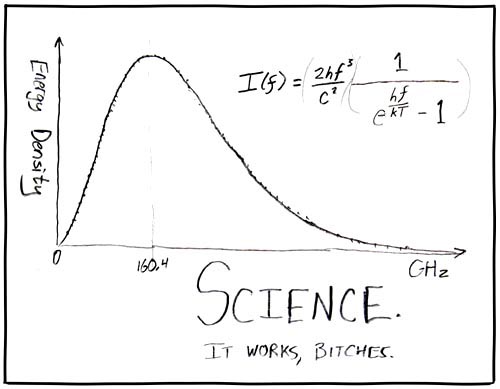
No word on whether the original diagram included the same caption. More information available from Backreaction. Graphic via XKCD.
Bulletin of the AMS, Vol. 43, No. 4
The latest issue of the Bulletin of the AMS is out. The feature article is Expander graphs and their applications by Hoory, Linial, and Wigderson. Expander graphs are a kind of graph that are important in computational complexity theory; we discussed them once before. Y.S. Sinai, a mathematician who works on topics quite close to physics, has an interesting article on the cultural differences called Mathematicians and physicists = cats and dogs?.
Whitehead problem
I was reading Hilton and Stammbach’s A Course in Homological Algebra, when I spotted this rather forlorn passage:
Of course, if A is free, Ext(A,Z) = 0, but it is still an open question whether, for all abelian groups A, Ext(A,Z) = 0 implies A free.
It is forlorn because we now know that we’ll never know: this is the Whitehead problem, and in 1973 Saharon Shelah proved that it is independent of the axioms of set theory.
247 anal sex amateur anal sex anal asian gay sex anal asian hot sex anal asian picture sex anal black sex anal demo sex video anal free sex anal gay sex anal hardcore sex anal movie sex anal penetration sex video anal porn free movie sex xxx anal porn sex anal sex anal sex clip anal sex free anal sex free pic anal sex free trailer anal sex gallery anal sex guide anal sex movie anal sex photo anal sex pic anal sex picture anal sex porn anal sex position anal sex pregnant anal sex site anal sex story anal sex technique anal sex teen anal sex tip anal sex toy anal sex trailer anal sex trailer video anal sex video anal sex video clip anal sex video virgin anal sex with young girl asian anal sex best lube for anal sex black anal sex black white anal sex blonde chick thirsty for anal sex catalog anal sex anal sex china doll rough sex anal pee christine young free anal sex video deep anal sex ebony anal sex extreme anal sex first anal sex first time anal sex first time anal sex video foxy lady 4 queen of anal sex free anal porn sex movie download free anal sex free anal sex clip free anal sex gallery free anal sex movie free anal sex movie gallery free anal sex pic free anal sex picture free anal sex video free granny anal sex free pic of anal sex gay anal sex gay anal sex video guide to anal sex hard anal sex hardcore anal sex hardcore gay anal sex her first anal sex her first anal sex devon lee homemade anal sex toy hot anal sex how to have anal sex interracial anal sex kinky anal sex latina anal sex lesbian anal sex male anal sex mature anal sex painful anal sex rough anal sex sex anal teen anal sex xxl sex anal young anal sex
Bounded Rationality
Ariel Rubinstein has made his book, Modeling Bounded Rationality, available online. Economic models tend to assume that humans are mistake-free calculating machines; economists have tried to introduce more realistic assumptions under the banner of bounded rationality. This is a far-from-settled problem, mainly because there are more ways to be wrong than there are to be right.