
Manifold Destiny

Sylvia Nasar and David Gruber got the only media interview of Perelman, by dint of actually going to Saint Petersburg and asking him for one. But the real subject of their article in the latest issue of the New Yorker, Manifold Destiny, A legendary problem and the battle over who solved it, is Shing-Tung Yau, who (if the article is to be believed) has systematically downplayed the significance of Perelman’s contribution. Reading the article, it’s hard to figure out what Yau’s motivation would be: possibilities seem to be his friendship with Richard Hamilton, a desire to emphasize his own contribution or that of his proteges. The article also reports on a feud that Yau had with Gang Tian in Chinese newspapers.

I don’t have any first-hand knowledge of any of this (I had seen some rumors here and there on the internet, but I’ve seen rumors that Iran would nuke the United States as of yesterday, which demonstrates the incredible reliability of internet rumors), but if the article is right, then I do see one motivation for Yau that I would even find admirable (though probably wrong-headed): to fight the growing tendency of considering an theorem proven if experts can fill in the details. “Experts” can mean fewer people than can fill a jury. In theory, you could just become an expert, but in any sufficiently technical field there will be results that “everyone knows” but won’t be published anywhere, so unless you are part of “everyone”, it will be difficult for you to fill in the gaps without a great deal of rediscovery. (I don’t know if that is the case with Perelman’s proof.)

Perelman comes across better in the article than I had expected, though his motivation for turning down the Fields seems to be less because of otherworldliness, and more because he feels hard done by the mathematics establishment. Amazingly, he really does live with his mother, and is currently unemployed (though retired might be a better way to describe it). He claims to have quit mathematics, but without an actual substitute, it’s easier to quit smoking.

(The article quotes a post by an unidentified Brazilian blogger. On a whim, I tracked the quote down in Google to this post by Victor Rivelles.

Link to New Yorker article via an anonymous commenter to Scott Aaronson’s blog.
2006 ICM Prizes

The 2006 Field Medalists have been announced:

Andrei Okounkov “for his contributions briding probability; representation theory and algebraic geometry.”

Grigori Perelman “for his contributions to geometry and his revolutionary insights into the analytical and geometric structure of the Ricci flow.”

Terence Tao “for his contributions to partial differential equations, combinatorics, harmonic analysis and additive number theory.”

Wendelin Werner “for his contributions to the development of stochastic Loewner evolution, the geometry of two-dimensional Brownian motion, and conformal field theory.”

The Nevanlinna Prize went to Jon Kleinberg, while the very first Gauss Prize was awarded to Kiyoshi Itō.

As was widely predicted, Perelman declined his prize, and did not attend the ICM.

Dark Matter, apparently not modern-day epicycles after all

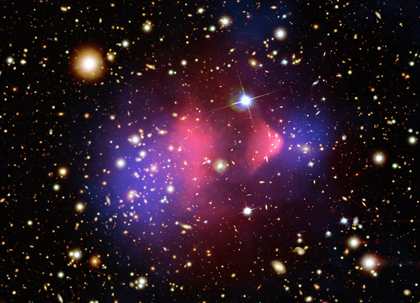
Well, John Baez was right, the mysterious NASA press release about a dark matter discovery was about the Bullet Cluster.

The discovery provides clear evidence in favor of dark matter, and against MOND. In the Bullet Cluster, when two clusters of galaxies collided, the regular matter in each cluster interacted, causing it to slow down, while the dark matter just kept going on its merry way. So while in a normal galaxy the gravitational forces pull towards the center of the visible galaxy, in the Bullet Cluster, the pull is now towards the bulge of dark matter to the side. It would be difficult to explain the discovery in the context of MOND — you would have to explain why in these particular galaxies the gravitational pull is asymmetric, while in most galaxies it’s symmetric.

So years of internet pundits are apparently wrong. Dark matter is not the new Ptolemaic epicycle. NASA’s article is here. Some animations of the collision can be found here.

NASA Announces Dark Matter Discovery

Physics weblogs are all abuzz over a mysterious press release put by NASA entitled NASA Announces Dark Matter Discovery. The main body of the announcement reads:

Astronomers who used NASA’s Chandra X-ray Observatory will host a media teleconference at 1 p.m. EDT Monday, Aug. 21, to announce how dark and normal matter have been forced apart in an extraordinarily energetic collision.

Via Backreaction.

Update. John Baez has been on the case, and he’s deduced the meat of the announcement: a collision of two clusters of galaxies has apparently pulled galaxies and their dark matter halos apart. This provides compelling evidence in favor of the actual existence of dark matter. He has more in the comments, and at his website.